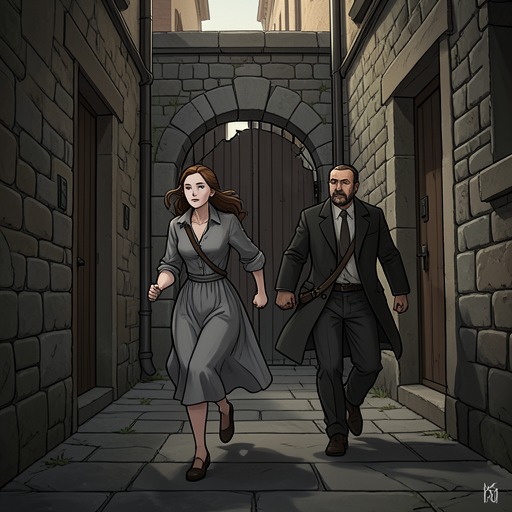
Furlong Takes Sarah Home from the Convent
Small Things Like TheseFurlong Takes Sarah Home from the Convent is the novel’s decisive act of rescue: Bill Furlong goes back to the convent, brings Sarah Redmond out, and walks with her toward his own home. The escape does not resolve what awaits them. Instead, it makes Furlong’s decision visible to the town and transforms his private understanding of injustice into an action whose consequences he expects to face.
Return to the convent
After circling the convent’s exterior, Furlong returns to its main entrance and goes up the driveway. The grounds look composed and beautiful, with yews, evergreens, and berries on the holly; the only footprints in the snow point faintly in the opposite direction. He passes the front door without meeting anyone, then goes around the gable to the coal-house door. The quiet approach gives way to a moment of hesitation: the need to open the door leaves him, then returns. He slides the bolt, calls Sarah by name, and gives his own.
The outward appearance of the grounds contrasts with what he has seen at the back of the building: high walls topped with broken glass, windows blackened over and fitted with metal grilles. Furlong had imagined the coal-house door might be locked, Sarah might not be there, or he might have to carry her. He had also wondered whether he would come at all. What he finds is still difficult, but Sarah takes his coat and seems glad to lean on him as he leads her out. His fears have not vanished; the difference is that he has acted despite them.
The walk into town
Furlong helps Sarah down the drive and hill, past the houses, and toward the bridge over the River Barrow. Without his coat, he feels the sharper air; within him, self-preservation competes with courage. He considers taking Sarah to the priests’ house, but his thoughts repeatedly reach the same conclusion: the priests already know. Mrs Kehoe had given him reason to believe as much. The possibility of handing Sarah over to another authority therefore offers no moral refuge, and he keeps walking with her.
Across the river, the Barrow’s dark current suggests a freedom Furlong cannot share: he envies the water’s sure course toward the open sea. The image runs against the constrained route the two must take through town, where Sarah’s bare feet make her condition visible. People Furlong has known for much of his life stop to speak, then notice her and recognize that she is not one of his own. Some keep their distance, others manage awkward conversation or offer a polite Christmas greeting. An elderly woman asks whether Sarah is one of the girls from the laundry. A boy calls her dirty after looking at her feet; his father sharply tells him to be quiet. Miss Kenny, seeing Sarah as one of Furlong’s own children, questions why she is outside in the snow without shoes and then marches on.
The encounters expose a difference between recognition and responsibility. The people they meet may identify Sarah’s connection to the laundry, but none addresses her or asks where Furlong is taking her. He feels little obligation to explain himself and smooths over what he can, continuing along the route he would ordinarily take. Near the town centre, he briefly considers turning back or choosing a longer way home. He does neither. Sarah has to stop and vomits in the street; he encourages her to get it out, attending to her immediate physical distress rather than withdrawing from the conspicuousness of their passage.
A public act of care
In the Square, Sarah pauses at the illuminated manger and looks at it as if transfixed. Furlong looks too: the figures include Joseph, the Virgin, sheep, the wise men, and the Baby Jesus. Sarah’s attention settles on the donkey. She reaches out to stroke it and brush snow from its ear, responding to this small, tangible detail amid a journey marked by exposure and exhaustion. The moment briefly shifts the walk from escape and public scrutiny to a simple gesture of tenderness.
As they continue, Furlong’s concern broadens from the immediate decision to the life he is choosing to lead. He asks himself whether life can be carried on without helping one another, and whether a person can call himself Christian while never daring to oppose what is in place. These reflections make the rescue more than an impulsive change of route. They show him measuring religious language against conduct, and recognizing that silence in the face of harm would have been a choice with its own lasting cost.
Consequences and significance
Walking beside Sarah brings Furlong an unfamiliar joy, even as he knows he will pay for what he has done. He compares it with the happiness he felt when his infant daughters were first placed in his arms, their cries healthy and insistent. The comparison gives the walk a personal as well as ethical force: his care for Sarah does not displace his family, but brings into the open a capacity for protection that he associates with fatherhood and human solidarity.
He also thinks of Mrs Wilson, whose daily kindnesses, corrections, encouragement, and refusals had accumulated into a life of help. Without her, his mother might have ended up in the very place from which he is now bringing Sarah. He imagines that, in an earlier time, he himself might have been saving his own mother. The parallel connects this rescue to his own history without making the two women’s circumstances identical: Furlong understands that another person’s past kindness helped shape the possibility of his present action.
Near his own front door, with Sarah barefoot beside him and a box of shoes in hand, Furlong expects trouble behind the next door. Fear now outweighs his other feelings, and he knows the worst may still be ahead. Yet the worse possibility, in his reckoning, is already behind him: the act he might have failed to do and would have had to live with. He does not claim certainty about what will follow. He hopes, and believes, that they will manage. The ending holds both danger and resolve together: bringing Sarah home begins a confrontation with consequences, but turning away would have left him with a consequence he could not escape.